Club Chronicle
Read the Club Chronicle for reports on our latest meeting and other past events.
(Latest update: 22 October 2026.)

22 October 2026: Feya and Mater: Support Dogs
We had two visitors today, Freya Levy and her support dog, Mater. It was unfortunate that, owing to holidays and illnesses, only six members attended. Freya and Mater didn’t seem to mind and the Ivy Hill Hotel catered for us superbly in their usual fashion.
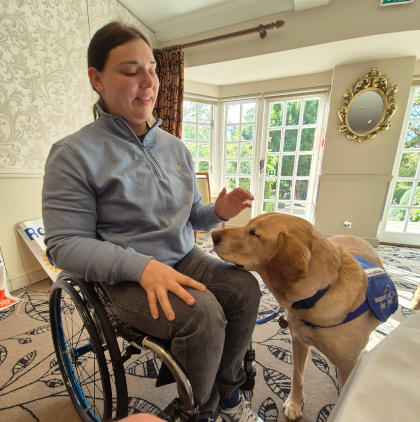 In a way Freya was just as interesting as Mater. She has suffered from multiple sclerosis for the last few years. Despite that she has been able to continue her sporting activities. She has been a member of our national wheelchair rugby and wheelchair netball teams. She no longer plays wheelchair rugby but she will shortly be travelling to Australia to support our national team.
She originally acquired Mater as a puppy intending him to be a pet and companion. She was with him in a park on one occasion when she dropped her purse. Mater automatically picked it up and dropped it in her lap. She wondered whether he could be trained to do that. She did some research online and discovered he could be trained by the charity Support Dogs, which is based in Sheffield. The start of his training coincided with the Covid lockdowns, so she left him there to undergo the first part of his training on his own. She rejoined him for the second part of his training. It normally takes between twelve and eighteen months to train a dog to give support to someone with disabilities.
With the end of his training and the end of the lockdowns, she was able to take him with her into public areas. At first he was very nervous in shops, possibly due to the confined space available. She helped him through that by taking him to shopping centres and encouraging to play with a ball there. That persuaded him that shops were a safe and fun place to be.
Unlike what Freya described as “life dependent dogs”, namely guide dogs and epilepsy dogs which have to concentrate on their owners all the time, disability dogs are perfectly happy to interact with other people. He certainly expected members sitting near them to make a fuss of him. We managed to get across to him that he would not like what we were eating!
Freya has a job in Marketing. She expressed a willingness to help us publicise our Club.
Rotary Young Musician District Final
Report by Anne Moriaty
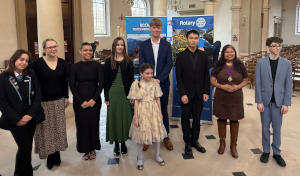 The District Final took place in Brentwood Cathedral on Saturday 28 February in the presence of the Deputy Mayor of Chelmsford, Cllr Smita Rajesh, and her consort.
The audience were treated to a lovely concert with high standard performances from five vocalists and six instrumentalists. Sadly there could only be two winners going through to the Regional Final and after lengthy deliberations the accolades went to pianist Tailin Liu sponsored by the Rotary Club of Bishops Stortford and vocalist Harry Sunderland sponsored by the Rotary Club of Dunmow.
Our Chelmsford winners, Henrietta Lawrence and Chloe Mahler were worthy runners-up.
I had the honour of giving out the certificates and the Deputy Mayoress presented the winner and runner-up trophies.
Collection for Marie Curie
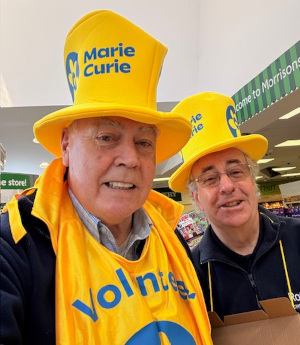 On 25 February 2026 President Graham, Francis Whitbread, Keith Dabbs, Anne Moriety and Steve, worked as a team at Morrisons Supermarket to collect monies on behalf of the Marie Curie charity. We collected a handsome sum, of which £80 was collected via card payment through the “SumUp” device. We enjoyed the day and special thanks to Francis who made the arrangements and remained all day throughout others’ slots. A photo opportunity could not go amiss.
 Contact Anne Moriaty about this page:
'What We Do' Main Pages: